Pawty Box
Building a themed pet-gifting brand from idea to physical product
Role: Founder · Product Designer · Brand Designer · E-commerce · Marketing · Operations Product: Themed gift boxes for dogs and cats Scope: Brand strategy, product development, sourcing, packaging, content, social media, influencer marketing, paid acquisition, fulfillment
The idea
I wanted to create something that turned buying a gift for a pet into an actual experience.
Pet products are often sold as individual commodities: a toy, a bag of treats, a collar, a bandana. I saw an opportunity to bring those products together into something more emotional and giftable — a box designed around a specific moment.
The idea behind Pawty Box was simple:
Every occasion deserves a pawty.
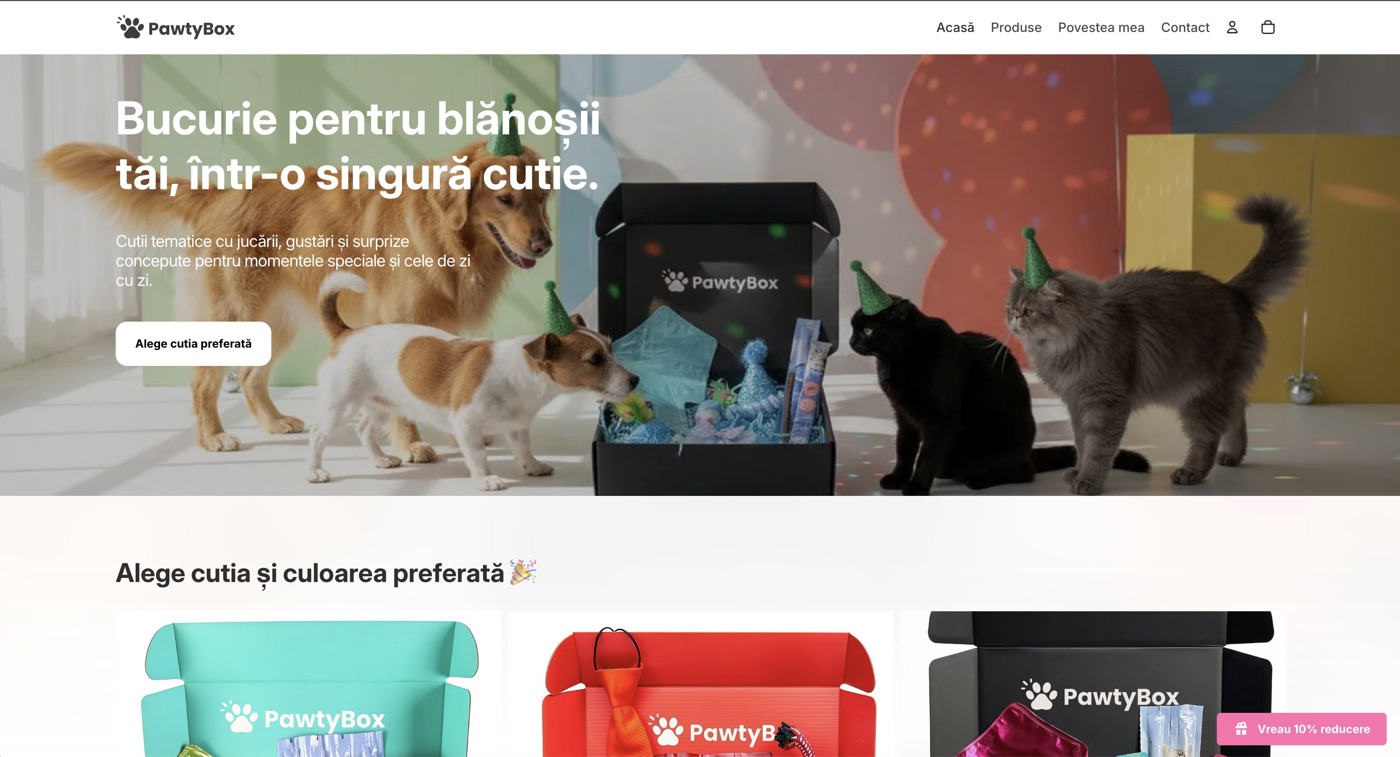
Instead of asking customers to search for individual products, I created ready-to-gift themed boxes containing a curated combination of toys, treats, accessories and party elements.
The product wasn't just the contents of the box. The unboxing, the visual identity, the occasion and the social-media moment were all part of the product.
01 — From idea to brand
I started Pawty Box from scratch, taking the idea from a blank page to a functioning consumer brand.
I developed the brand identity around the idea of celebrating pets like members of the family.
The visual direction was designed to feel:
- playful
- colorful
- joyful
- giftable
- highly visual
- social-media friendly
I developed the brand's visual language across the packaging, social media, product photography and promotional materials, making sure the experience felt cohesive from the first impression to the moment the customer opened the box.
02 — Product development & sourcing
There was no existing product to simply sell, so I had to build the product itself.
I researched different types of products that could work inside the boxes, including:
- dog toys
- cat toys
- treats
- accessories
- bandanas
- bow ties
- party hats
- balloons
- seasonal decorations
- giftable accessories
I sourced products internationally, including working with suppliers in China.
This involved researching suppliers, comparing products, evaluating pricing and minimum order quantities, ordering samples, assessing quality and figuring out which products made sense commercially.
The challenge wasn't simply finding inexpensive products.
I had to think about: would the product fit the brand? Would it look good inside the box? Would customers perceive it as valuable? Would it photograph well? Would it work with the theme? Could I sell the complete box at a viable margin?
I essentially treated every box as a small product line.
03 — Designing the product around occasions
One of the most important product decisions was to avoid creating just one generic box.
Instead, I created occasion-based collections.
Examples included:
Christmas
A festive box designed around Christmas gifting.
Valentine's Day
A romantic / cute theme focused on celebrating the relationship between pets and their owners.
Summer
Bright, playful products designed around summer and outdoor fun.
Wedding
A special-edition box for couples including their pets in their wedding celebrations.
Birthdays
Boxes designed specifically around celebrating a pet's birthday.
The occasion became part of the product itself. This also created a natural reason for customers to purchase repeatedly throughout the year.
04 — Building the e-commerce experience
I created the online presence for Pawty Box and translated the physical product into a digital shopping experience.
This included:
- creating the website
- structuring the product catalog
- creating product descriptions
- defining product variants
- creating promotional imagery
- creating social media profiles
- developing launch content
- communicating the value proposition
- creating campaigns around seasonal launches
The goal was to make the product immediately understandable: what is it, who is it for, what's inside, why is it special, why should I buy it now.
05 — Creating the content engine
Because Pawty Box was a highly visual product, content was not an afterthought. Content was part of the product strategy.
I created imagery for the brand using a combination of:
- physical product photography
- styled photoshoots
- graphic design
- AI-generated imagery
- promotional compositions
- social media assets
I used AI to create promotional scenes and concepts that would have been expensive or difficult to produce through traditional photography alone. This allowed me to experiment with different visual directions and create more content around the brand without requiring a full production team.
06 — Photoshoots & visual merchandising
I also produced physical photoshoots for the boxes.
I had to think about styling, composition, props, lighting, product arrangement, the order in which products appeared, how the box would look when opened, and how individual products would look on social media.
This was important because the product had two audiences:
the pet — who gets to play with/eat/use the products
and
the human — who is buying the experience and sharing it.
The box therefore had to be functional and photogenic.
07 — Building awareness from zero
Starting with no audience meant that I couldn't rely on organic brand recognition. I experimented with several acquisition channels.
Giveaways
I created giveaways designed to increase brand awareness, social followers, engagement, user-generated content and visibility within the pet community. The giveaways were designed as a mechanism for getting Pawty Box in front of potential customers and encouraging people to interact with the brand.
08 — Pet influencer strategy
I identified pet influencers as a natural acquisition channel. Instead of advertising only to pet owners directly, I could put the product in the hands of people whose entire audience was already interested in pets.
I selected relevant pet accounts and sent them Pawty Boxes to create authentic content around the product. The boxes effectively became PR packages.
This created opportunities for unboxing videos, product photography, Instagram posts, stories, pet photos, recommendations and user-generated content.
The strategy was particularly relevant because the product itself was designed to be visually shareable. Pet brands today continue to use this kind of social-first content model, where products are intentionally designed to create moments people want to photograph and share.
09 — Paid acquisition
I also experimented with Facebook advertising. Rather than simply promoting the brand broadly, I used paid social to test different audiences, creative concepts, products, offers, seasonal themes and messaging.
This helped me understand which combinations generated interest and which types of creative were more compelling.
The experience taught me an important product lesson:
A great product isn't enough. You have to communicate the value of the product in the first few seconds.
10 — Fulfillment & operations
Pawty Box wasn't just a digital product. I personally handled the physical operation behind it.
That included receiving inventory, organizing products, storing stock, selecting products for each order, assembling boxes, packing orders, preparing shipments, managing packaging materials and coordinating fulfillment.
I experienced the entire journey from supplier → inventory → product assembly → customer.
That gave me a much deeper understanding of the operational constraints behind seemingly simple product decisions. For example, adding one inexpensive item to a box isn't necessarily inexpensive once you consider product cost + shipping + storage + packaging + fulfillment time + customer value + margin.
11 — Designing for repeat purchases
Themed editions were also a retention strategy. Instead of asking "why would someone buy another Pawty Box?", I created a product architecture where the answer was built into the calendar.
A customer could buy: Birthday → Valentine's Day → Summer → Halloween → Christmas → another birthday
The product therefore moved from being a one-time gift into something that could become a recurring part of a pet owner's celebrations.
12 — What I learned
Pawty Box taught me what it actually takes to take a physical consumer product from idea → market.
I wasn't working inside one predefined role. I was simultaneously:
Product Manager — defining the product, customer proposition, product variants and roadmap.
Product Designer — designing the customer experience and thinking through how the product should work and feel.
Brand Designer — creating the visual identity and maintaining consistency across touchpoints.
Growth Marketer — testing giveaways, influencers, organic content and paid advertising.
Content Creator — creating photography, promotional imagery and AI-generated creative.
E-commerce Manager — building the online storefront, products and merchandising.
Sourcing Manager — researching suppliers, ordering samples and managing international sourcing.
Operations Manager — managing inventory, assembling boxes and fulfilling orders.
Founder — making the decisions, testing assumptions and learning from the market.
The bigger product lesson
The biggest lesson from Pawty Box was that the product isn't just what's inside the box.
The product was the entire experience:
Discovery → anticipation → purchase → delivery → unboxing → pet interaction → photography → social sharing → future occasion
That changed the way I think about product development. I learned to look beyond the core feature or physical object and think about the complete customer journey — including the emotional and social value surrounding the product.
Pawty Box was my hands-on experience of building a consumer product from zero, validating a concept through real-world execution, and connecting product, design, branding, marketing and operations into one cohesive experience.